
Infrared Thermal Imaging for Home Inspections in Ottawa
By Darren McClurg, CMI ·

Infrared Thermal Imaging for Home Inspections
Superman had x-ray vision. Doctors use x-rays and MRI’s to look inside your body. The military and police use infrared to find suspects hiding in the bushes. A few top notch home inspectors are starting to use Infrared Thermal Imaging Cameras (also know as IR cameras) for the same reasons. With this technology,
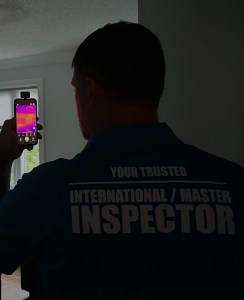
I use only the latest Thermal Imaging Technology, to give you the best quality!
they are able to detect some problems that are not visible to the naked eye. While it does not give the inspector super-human powers, it does give them an edge on finding anomalies in a house that might not otherwise be discovered. The Real Estate Inspection Company has been using IR cameras since 2005, and the results are fantastic. Just like smart phones, satellite TV, and MP3 players, the technology is amazingly complex. but using them is fairly simple. So how do we use this technology to do a better inspection? First let’s talk about temperature and thermal mass. You can think of thermal mass as the inertia against temperature change. That means items with different thermal mass will change temperature at different rates. In reference to building materials, a dry item will heat up more quickly than an item with more moisture. Dry sheetrock will warm up more quickly than a 2 x 4 piece of wood. Or for the purpose of our discussion, wet areas of sheetrock will change temperature at a different rate than dry sheetrock. The change in temperature is referred to as “Delta T”. So what does all this mean to a home inspection? Infrared Cameras “see” in the infrared spectrum, or in other words, it “sees” the heat emitted by items and converts it into an image that humans can see. Since everything has a temperature, the camera is a very effective tool to show us how items are heating or cooling. Even items in your freezer have different temperatures based on their thermal mass. An ice cube has a different thermal mass than a frozen piece of bread, and the bread will heat up more quickly than the ice cube when removed from the freezer.
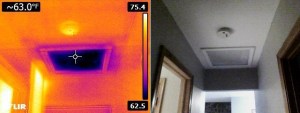
The attic access is only a thin board, the darker the area the more of a exterior air leak into the home
Performing an IR scan of a house involves a few steps. First, we run all the plumbing in the house. Running the water in upstairs bathrooms is particularly important because shower pans and tubs are a frequent source of leaks. At the same time we will turn on the furnace. The furnace will start to warm up interior surfaces of the house (obviously). But any areas that are wet will not heat up as quickly. When looked at with the IR camera, the wet areas will stand out as a cold spot when compared to the surrounding areas, unable to heat up as quickly as the dry areas due to higher thermal mass. Evaluating the home for leaks with an IR Camera is a simple process, but one that most home inspectors do not use (The cameras are very expensive ranging from $6,000 – $12,000). And with many bank-owned homes getting a quick paint job for a fast sale, water stains may be covered up. Evidence of a leak will be overlooked by most home inspectors. But the IR camera can “see” these leaks even through a new paint job.
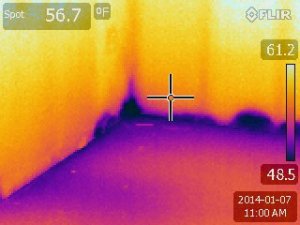
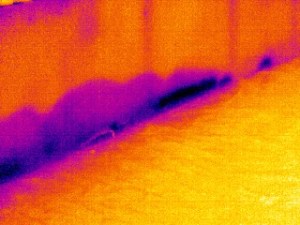
Extensive water damage in finish basement, that wasn’t seen by home owners is naked eye
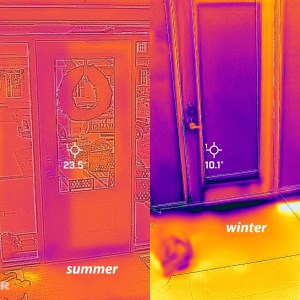
Infrared cameras work best in the winter because of the large temperature difference between the inside and outside of a building. Here are some differences between using an infrared camera in the summer and winter:
-
Temperature difference
In the winter, the large temperature difference between the inside and outside of a building makes it easier to identify areas of heat loss. In the summer, the sun can transfer heat into the building, making the air conditioning work harder.
-
Humidity
In the summer, the higher humidity levels can cause more infrared radiation to be lost.
-
Weather conditions
Fog and rain can limit the range of an infrared camera because water droplets scatter light.
-
Thermographic scans
In northern states, thermographic scans are usually done in the winter. In southern states, scans are usually conducted during warm weather with the air conditioner on.
-
Seeing animals
In the summer, it’s easier to see animals in open spaces. In the winter, it’s easier to spot animals in the dark, but it’s harder to see environmental details.
Here is an example, builders aren’t always as clever as they sound?! I showed a slight air leak around a front exterior door, the builder replaced it & said it was better?! It just made the situation worst!
Plumbing leaks are only one defect that we search for with the IR camera. It is an effective tool to find roof leaks after a recent rain. It can also be used to find missing insulation, open or leaking ducts, and over-heated circuit breakers. So when evaluating which home inspection company to hire, here is Ottawa’s top home inspector that uses only the latest & best equipment for you in each inspection. The infrared inspection will be included with every inspection & is worth it. Contact Bent Nails today for a quote!